These cards summarize the existing study. Open the full study for its argument, sources and qualifications.
Editorial summary · not a quotation
Two distinct communions
Oriental Orthodoxy and Chalcedon
Eastern Orthodox churches receive Chalcedon and the subsequent Ecumenical Councils. Oriental Orthodox churches, including the Coptic, Armenian, Syriac, Ethiopian, Eritrean, and Malankara traditions, have a different history of reception after the fifth-century controversies. The names can sound similar, but they do not designate one communion. Their separation involved doctrinal vocabulary, ecclesial relations, and historical circumstances. An accurate account should not describe every non-Chalcedonian Christian as a follower of every teaching condemned during those controversies or treat historical accusations as self-explanatory.
Eastern Orthodoxy confesses one Person in two natures without confusion or separation. Oriental Orthodox teachers also reject the Eutychian absorption or confusion of Christ’s humanity and affirm that He is truly divine and truly human. Their miaphysite vocabulary is not accurately summarized as denying that Jesus has a human body or soul. Modern dialogue has identified substantial agreement in Christological confession, but interpreting formulas requires attention to how nature and person are being used and to the wider ecclesial reception of the statements.
Dialogue is not a declaration of restored communion
Oriental Orthodoxy and Chalcedon
Theological agreements and respectful relations are important but do not automatically establish full Eucharistic communion for all churches involved. Outstanding questions concern reception, councils, anathemas, and practical ecclesial relations. Local pastoral arrangements cannot be turned into a worldwide rule without checking the responsible authorities. Speak truthfully about the current distinction, and do not imply that goodwill alone settles every doctrinal or canonical issue. For a family, baptismal, or Communion question, seek a canonical parish’s guidance rather than relying on the similarity of church names.
Eastern Orthodox and Oriental Orthodox churches are distinct communions. Their separation concerns the reception of Chalcedon and subsequent Christological controversies. Modern dialogue has identified substantial agreement in confessing the fullness of Christ’s divinity and humanity.
Oriental Orthodox Christians reject Eutychian confusion of Christ’s natures; simply calling them people who deny His humanity is false. Dialogue does not mean full Eucharistic communion has universally been restored.
01Two distinct communions
Eastern Orthodox churches receive Chalcedon and the subsequent Ecumenical Councils. Oriental Orthodox churches, including the Coptic, Armenian, Syriac, Ethiopian, Eritrean, and Malankara traditions, have a different history of reception after the fifth-century controversies. The names can sound similar, but they do not designate one communion. Their separation involved doctrinal vocabulary, ecclesial relations, and historical circumstances. An accurate account should not describe every non-Chalcedonian Christian as a follower of every teaching condemned during those controversies or treat historical accusations as self-explanatory.
02The fullness of Christ’s humanity
Eastern Orthodoxy confesses one Person in two natures without confusion or separation. Oriental Orthodox teachers also reject the Eutychian absorption or confusion of Christ’s humanity and affirm that He is truly divine and truly human. Their miaphysite vocabulary is not accurately summarized as denying that Jesus has a human body or soul. Modern dialogue has identified substantial agreement in Christological confession, but interpreting formulas requires attention to how nature and person are being used and to the wider ecclesial reception of the statements.
03Dialogue is not a declaration of restored communion
Theological agreements and respectful relations are important but do not automatically establish full Eucharistic communion for all churches involved. Outstanding questions concern reception, councils, anathemas, and practical ecclesial relations. Local pastoral arrangements cannot be turned into a worldwide rule without checking the responsible authorities. Speak truthfully about the current distinction, and do not imply that goodwill alone settles every doctrinal or canonical issue. For a family, baptismal, or Communion question, seek a canonical parish’s guidance rather than relying on the similarity of church names.
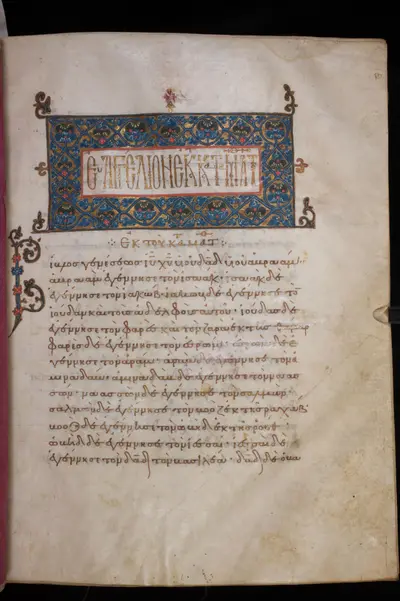
A page of a Greek Byzantine Gospel book, Minuscule 106, Chester Beatty Library W 135, folio 10r. Scripture itself is the shared subject, not a portrait assigned to a modern denomination.