These cards summarize the existing study. Open the full study for its argument, sources and qualifications.
Editorial summary · not a quotation
Identify the particular tradition
Protestant traditions: Scripture, authority and salvation
Protestant is a broad historical description, not the name of one church with one complete doctrine. Lutheran, Reformed, Anglican, Methodist, Baptist, and Pentecostal traditions differ over authority, sacraments, ministry, and spiritual life. Some communities within those families differ further. A fair comparison begins by asking which confession or church is under discussion. Many confess the Trinity and Christ’s complete divinity and humanity; other groups using Christian language do not, and should not be silently treated as representative of all Protestants.
Protestant traditions: Scripture, authority and salvation
Orthodoxy receives Scripture within Holy Tradition and the Church’s sacramental and conciliar life. Many Protestant traditions emphasize Scripture as the final norm and evaluate traditions under that norm, but they still use interpretation, preaching, confessions, and inherited practices. It is misleading to say that they have no tradition at all. The actual disagreement concerns the authority and continuity of Tradition, the Church’s role in interpretation, and the nature of ministry and communion. These questions need historical and doctrinal treatment, not simply competing claims to read the Bible literally.
Protestant traditions: Scripture, authority and salvation
The expression faith alone has different explanations and must be read in its own tradition’s terms. Many Protestants teach that good works necessarily follow living faith while denying that works earn justification. Orthodox teaching likewise rejects self-salvation but describes the life of grace through repentance, sacramental communion, synergy, and theosis. Comparison should identify genuine differences without making either side say what it does not teach. Discuss saints, icons, and Eucharistic life with precise definitions, and avoid judging another person’s final relationship to God from a denominational label alone.
Many Protestants share Trinitarian belief and confess Jesus Christ as Lord. Orthodoxy differs from many Protestant traditions over Scripture and Tradition, ecclesial authority, sacramental life and the place of saints and icons.
Protestantism is not one denomination. Lutheran, Reformed, Anglican, Methodist, Baptist, Pentecostal and other communities differ substantially; “faith alone” must be explained in the terms of the particular tradition being discussed.
01Identify the particular tradition
Protestant is a broad historical description, not the name of one church with one complete doctrine. Lutheran, Reformed, Anglican, Methodist, Baptist, and Pentecostal traditions differ over authority, sacraments, ministry, and spiritual life. Some communities within those families differ further. A fair comparison begins by asking which confession or church is under discussion. Many confess the Trinity and Christ’s complete divinity and humanity; other groups using Christian language do not, and should not be silently treated as representative of all Protestants.
02Scripture and ecclesial authority
Orthodoxy receives Scripture within Holy Tradition and the Church’s sacramental and conciliar life. Many Protestant traditions emphasize Scripture as the final norm and evaluate traditions under that norm, but they still use interpretation, preaching, confessions, and inherited practices. It is misleading to say that they have no tradition at all. The actual disagreement concerns the authority and continuity of Tradition, the Church’s role in interpretation, and the nature of ministry and communion. These questions need historical and doctrinal treatment, not simply competing claims to read the Bible literally.
03Faith, works, and a holy life
The expression faith alone has different explanations and must be read in its own tradition’s terms. Many Protestants teach that good works necessarily follow living faith while denying that works earn justification. Orthodox teaching likewise rejects self-salvation but describes the life of grace through repentance, sacramental communion, synergy, and theosis. Comparison should identify genuine differences without making either side say what it does not teach. Discuss saints, icons, and Eucharistic life with precise definitions, and avoid judging another person’s final relationship to God from a denominational label alone.
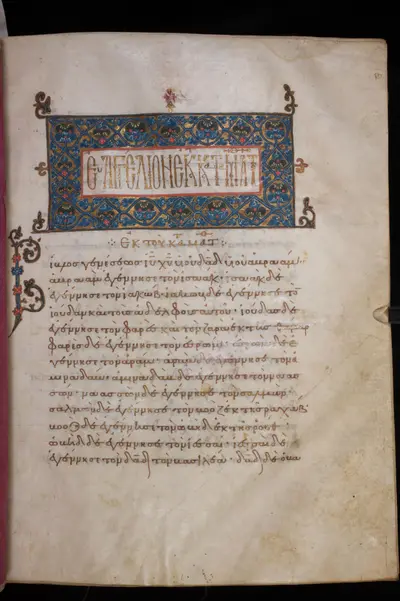
A page of a Greek Byzantine Gospel book, Minuscule 106, Chester Beatty Library W 135, folio 10r. Scripture itself is the shared subject, not a portrait assigned to a modern denomination.